
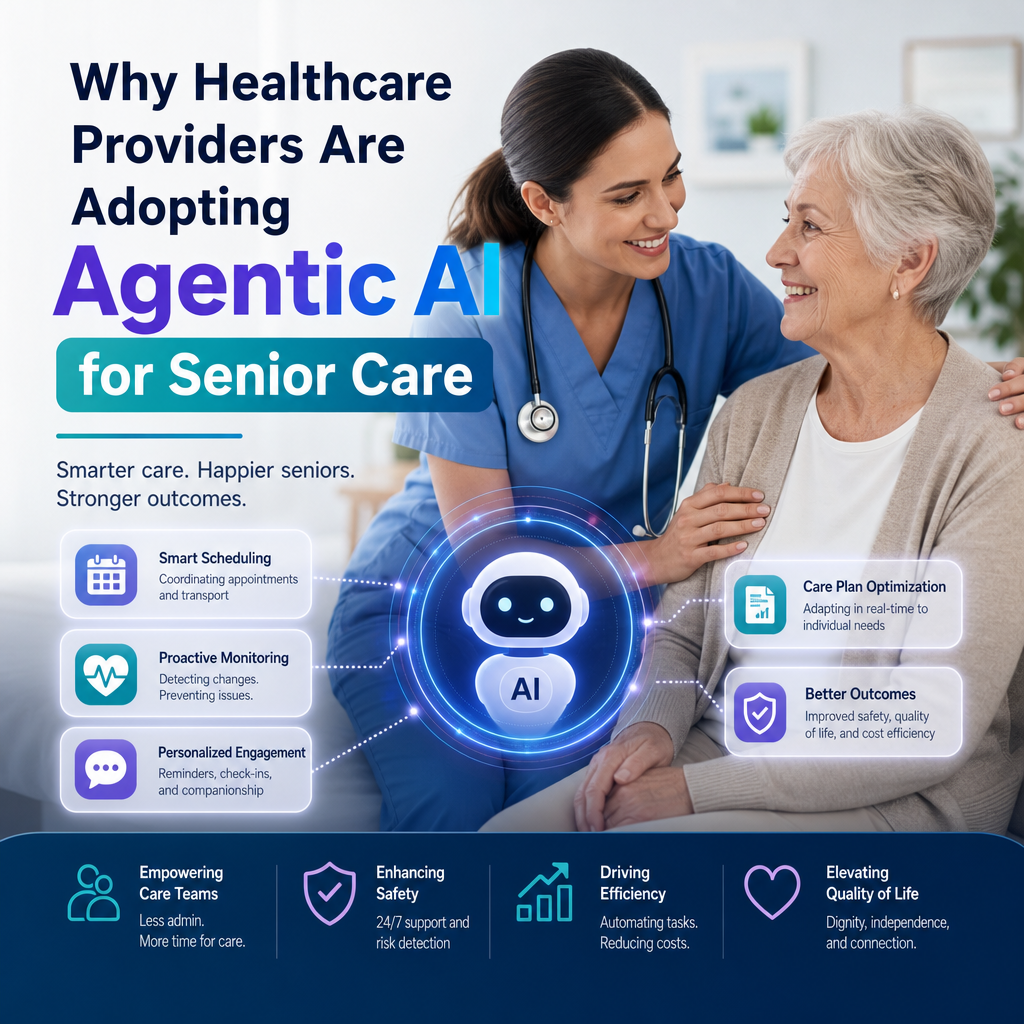
Why Healthcare Providers Are Adopting Agentic AI for Senior Care
The Growing Need for Smarter Senior Care
Healthcare providers are under increasing pressure to deliver better care for older adults while managing rising costs, staffing shortages, and more complex medical needs. Seniors often require ongoing support across multiple conditions, medications, specialists, and care settings. Traditional systems were not designed to handle that level of complexity efficiently.
That is why more organizations are exploring agentic AI for senior care management. Unlike basic automation tools, agentic AI can take goal-oriented actions, monitor changing conditions, prioritize tasks, and support care teams in real time. For providers, this means a new way to improve coordination, responsiveness, and patient outcomes without adding more administrative burden.

What Makes Agentic AI Different?
Most healthcare teams are already familiar with AI tools that summarize notes, flag risks, or automate routine workflows. Agentic AI goes a step further.

From passive analysis to active support
Agentic AI systems do more than simply generate insights. They can:

- track patient status continuously
- identify gaps in care plans
- prompt follow-up actions
- coordinate with existing systems and workflows
- help teams respond faster to emerging concerns
For senior care, this matters because older adults often need timely interventions. A missed appointment, a medication conflict, or a small change in mobility can quickly become a serious issue.
Why Providers Are Moving Toward Agentic AI
Healthcare providers are not adopting new technology just for innovation’s sake. They are doing it because current senior care models are difficult to sustain.

1. Aging populations are increasing demand
The number of older adults is rising in many regions, and many of them are living with chronic conditions such as diabetes, heart disease, dementia, or arthritis. These patients need more frequent check-ins, more coordinated care, and more support outside the clinic.

Agentic AI for senior care management helps providers scale these efforts. It can monitor patient patterns, recommend next steps, and surface which patients may need attention before a problem escalates.
2. Care teams are stretched thin
Nurses, care coordinators, case managers, and physicians often spend too much time on administrative work. Phone calls, reminders, documentation, scheduling, and care plan updates all consume valuable time.
Agentic AI can reduce that load by handling repetitive tasks and organizing information across systems. Instead of replacing clinicians, it helps them focus on human-centered care such as decision-making, relationship building, and complex interventions.
3. Senior care requires better coordination
Older adults frequently receive care from multiple providers, including primary care physicians, specialists, home health agencies, family caregivers, and community support services. Without strong coordination, important information can be delayed or lost.
An agentic AI system can act as a coordination layer. It can help align follow-ups, track open tasks, identify care gaps, and ensure that the right people are informed at the right time.
Key Benefits in Senior Care Management
The strongest case for adoption is practical impact. Providers want tools that improve care while making operations more efficient.
Proactive risk detection
One of the biggest advantages of agentic AI is the ability to spot early warning signs. A senior who misses medication refills, reports lower activity, or shows subtle changes in communication may be at higher risk for hospitalization or decline.
By identifying those patterns early, providers can intervene sooner.
More personalized care plans
No two senior patients have the same needs. Agentic AI can help tailor care plans based on medical history, behavior trends, social factors, and treatment goals. That allows providers to offer more relevant support instead of using one-size-fits-all workflows.
Better patient engagement
Many seniors need ongoing reminders and encouragement to stay on track with appointments, medications, rehabilitation, and preventive care. Agentic AI can support outreach through timely prompts and follow-up communication, helping patients remain engaged between visits.
Reduced avoidable costs
Emergency visits, readmissions, and unmanaged chronic conditions are expensive. When providers can detect issues earlier and coordinate care more effectively, they can reduce unnecessary utilization and improve value-based care performance.
Real-World Use Cases
Healthcare organizations are integrating agentic AI into senior care management in several practical ways.
Common applications include:
- medication adherence monitoring
- appointment and follow-up coordination
- discharge planning support
- chronic disease management
- fall risk and mobility monitoring
- caregiver communication support
- prioritization of high-risk patients for outreach
These use cases are especially valuable in home-based care and remote monitoring programs, where providers need visibility without requiring constant in-person visits.
Important Considerations Before Adoption
While the benefits are compelling, implementation must be thoughtful.
Trust, privacy, and oversight matter
Senior care involves highly sensitive data and important clinical decisions. Providers need systems that are transparent, secure, and designed for human oversight. Agentic AI should support staff, not operate without accountability.
Integration is essential
A powerful tool is only useful if it fits existing workflows. Providers are more likely to succeed when agentic AI connects with electronic health records, communication platforms, and care management systems already in use.
Human care remains central
Technology can improve speed and consistency, but it cannot replace empathy, judgment, and personal connection. The most effective strategy is to use agentic AI to strengthen the work of clinicians and caregivers, not to remove them from the process.
The Future of Senior Care Management
The shift toward agentic AI for senior care management reflects a larger change in healthcare. Providers are moving from reactive care to proactive, continuous support. For senior populations, that shift is especially important.
As care needs become more complex and workforce challenges continue, agentic AI offers a practical way to improve coordination, reduce strain on teams, and deliver more responsive care. Healthcare providers are integrating it not because it is trendy, but because senior care increasingly demands tools that can act intelligently, adapt quickly, and help people stay healthier for longer.