

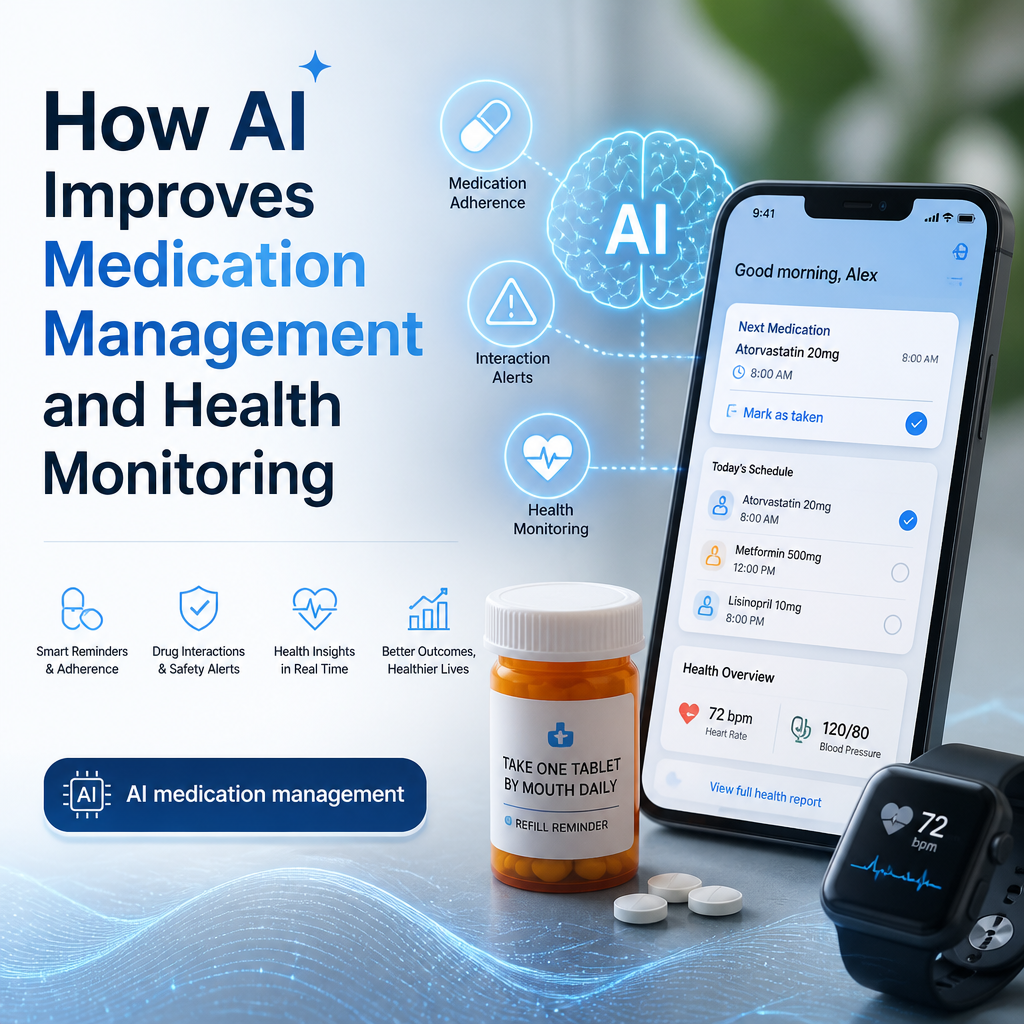
How AI Improves Medication Management and Health Monitoring
The Role of AI in Medication Management and Health Monitoring
Managing medication and keeping track of health can be challenging, especially for people living with chronic conditions or taking several prescriptions. Artificial intelligence (AI) is helping make these tasks more organized and personalized. From reminders that support daily routines to systems that identify changes in health data, AI can assist patients and care teams—while leaving important medical decisions in human hands.
How AI Supports Medication Management
Taking the right medicine at the right time is essential, but missed doses, confusing instructions, and complex schedules can make adherence difficult. AI-powered tools can help patients manage these routines more consistently.

Personalized reminders and guidance
Medication apps can send reminders based on a person’s schedule and preferences. Some tools also help organize medicines by dose and time, track whether a dose was taken, and notify users when a prescription may need refilling. More advanced systems can adapt reminders when routines change, such as during travel or after a shift in a medication schedule.

These tools may be especially useful for people managing multiple prescriptions. A clear, consolidated schedule can reduce confusion and help patients prepare informed questions for their pharmacist or doctor.

Checking for potential risks
AI systems may help review medication lists and flag potential concerns, such as possible interactions, duplicate therapies, or doses that appear inconsistent with a patient’s health information. In clinical settings, these alerts can support pharmacists and clinicians as they review treatment plans.
However, an alert is not a diagnosis or a final decision. Medication safety depends on context, including a patient’s medical history, test results, other medicines, and individual circumstances. Patients should consult a qualified health professional before starting, stopping, or changing a medication.

AI and Everyday Health Monitoring
Health monitoring increasingly involves data from wearable devices, home testing equipment, and electronic health records. AI can help organize and interpret these information streams, making it easier to spot patterns that might otherwise be difficult to notice.

Finding patterns in health data
Wearables may track measures such as heart rate, activity, sleep, or blood oxygen levels. AI can analyze these readings over time and highlight changes—for example, a shift in a person’s usual activity or resting heart rate. Home devices can also support monitoring of blood pressure or blood glucose, depending on the person’s needs and care plan.
The value is often less about a single reading and more about trends. A clinician may be able to review a longer record of measurements rather than relying only on information gathered during an occasional appointment. This can support more timely conversations about symptoms, treatment, or follow-up care.
Supporting remote care
Some healthcare services use AI-assisted monitoring to help care teams prioritize which patients may need attention. If a system detects readings outside a set range or a significant change from a patient’s typical pattern, it may prompt a review or alert a care professional.
These systems can help extend care beyond the clinic, but they do not replace professional assessment. Device readings can be inaccurate, and unusual results do not always mean a serious problem. Patients should follow the instructions provided by their healthcare team and seek urgent care when they experience emergency symptoms.
Benefits—and Important Limitations
AI can make health information easier to manage, encourage consistent medication routines, and help clinicians notice meaningful patterns. It may also support more personalized care by bringing together information gathered over time.
Still, AI tools have limitations. Their recommendations depend on the quality and completeness of the data they receive. A device may record an incorrect reading, while an algorithm may overlook factors that a clinician would recognize. Systems can also perform differently across populations if they were not developed and tested with diverse groups.
Privacy is another key consideration. Health data is sensitive, so users should understand what information an app or device collects, how it is stored, and whether it is shared. Choosing reputable tools and discussing their use with a healthcare professional can help people make informed decisions.
Using AI as a Partner in Care
AI is most useful when it supports communication rather than replacing it. Patients can use digital tools to keep track of medicines, record symptoms, and bring useful summaries to appointments. Clinicians can use AI-generated insights as one source of information alongside examination, patient preferences, and established medical guidance.
The role of AI in medication management and health monitoring will continue to grow. Used carefully, these tools can make everyday care more manageable and help people take a more active role in their health. The strongest results come when technology, patients, pharmacists, and clinicians work together.