
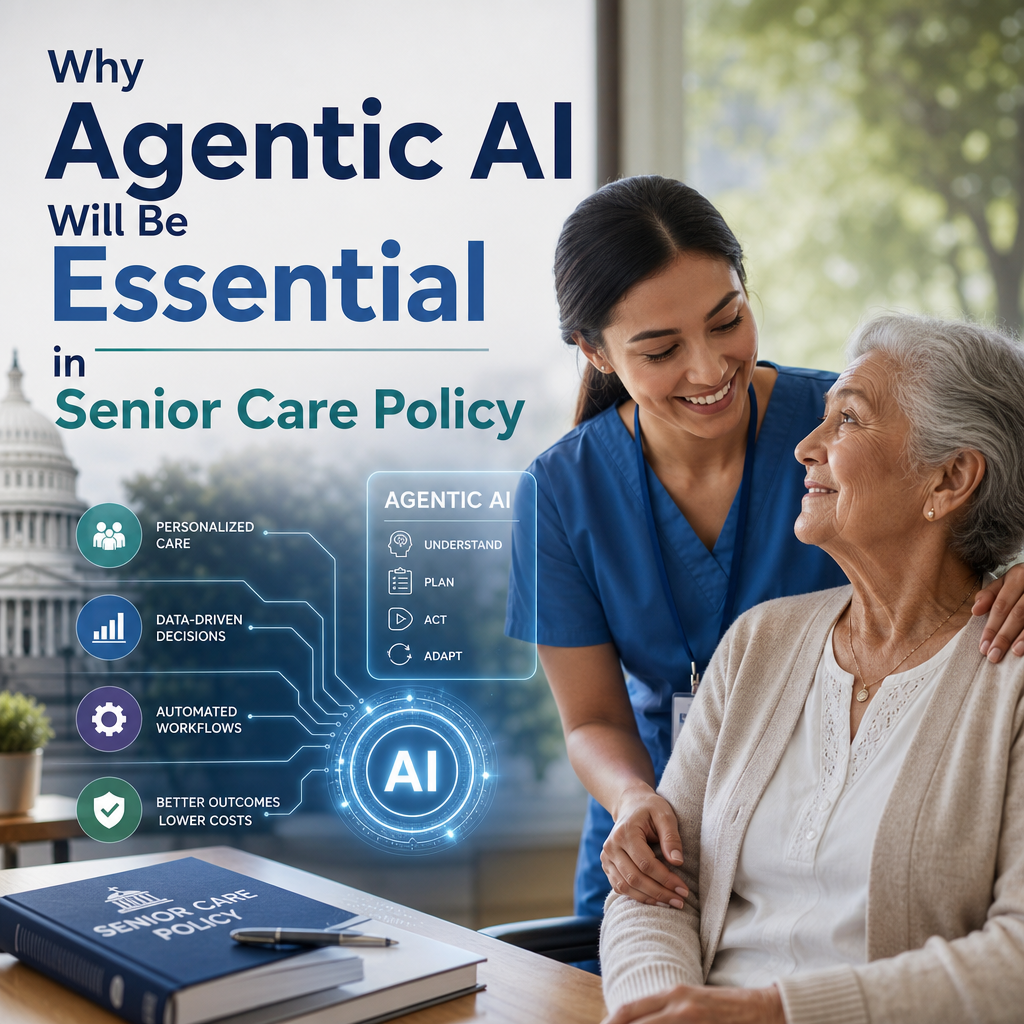
Why Agentic AI Will Be Essential in Senior Care Policy
Aging populations are putting senior care systems under stress almost everywhere. Over the next decade, the question for policymakers will not be whether technology belongs in elder care, but how quickly it can be governed and scaled. That is why Agentic AI is likely to move from an interesting innovation to a practical requirement in senior care policy.
Unlike traditional software that only follows rigid instructions, Agentic AI can interpret goals, monitor changing conditions, and take limited actions across systems with human oversight. In senior care, that means support that is more adaptive, more continuous, and more responsive than today’s fragmented care models.

The Demographic Pressure Is Becoming Impossible to Ignore
Senior care policy is being reshaped by a simple reality: more older adults will need more support, while the care workforce is already stretched thin.

Many countries are facing:

- Rising life expectancy
- Higher rates of dementia and chronic disease
- More seniors living alone
- Persistent shortages of nurses, aides, and care coordinators
- Growing public spending on long-term care
This creates a policy gap. Governments must provide safer, more personalized care without relying only on expanding human labor, which is costly and increasingly scarce.
That is where Agentic AI becomes more than a convenience. It becomes infrastructure.

What Makes Agentic AI Different in Senior Care?
Most digital tools in care settings today are passive. They store records, trigger simple alerts, or support scheduling. Agentic AI is different because it can actively help manage care goals across multiple settings.

Examples of what Agentic AI can do
In senior care, an agentic system could:
- Detect medication adherence problems and notify caregivers
- Coordinate transportation for medical appointments
- Track changes in mobility or sleep patterns from home sensors
- Escalate risks to clinicians before an emergency occurs
- Help families understand care plans in plain language
- Automate routine documentation for care staff
This matters because older adults often move between home care, hospitals, rehabilitation, and assisted living. The biggest failures in senior care usually happen in those transitions. Agentic AI can help close those gaps in real time.
Why Policy Will Likely Make It Mandatory
The word “mandatory” may sound strong, but in policy terms it often means something practical: systems become so necessary for safety, cost control, and accountability that regulators begin requiring them in some form.
1. Safety standards will rise
Senior care policy is increasingly focused on prevention rather than reaction. Falls, missed medications, dehydration, wandering, and delayed treatment all create avoidable harm.
If Agentic AI proves it can reliably reduce these risks, regulators may begin to expect its use in high-risk environments, especially where staffing ratios are low or patients have complex needs.
2. Workforce shortages will force automation
Care workers should never be replaced where human presence is essential. But a large share of their time is consumed by coordination, reminders, reporting, and administrative tasks.
Policy leaders will likely view Agentic AI as a way to protect the workforce by reducing burden, not just cutting costs. Over time, care systems that do not adopt these tools may struggle to meet minimum service expectations.
3. Public budgets will demand measurable efficiency
Senior care is expensive, and the costs are rising fast. Governments and insurers will increasingly favor tools that reduce hospital readmissions, delay institutionalization, and improve continuity of care.
If Agentic AI can demonstrate better outcomes per dollar spent, reimbursement models and procurement rules may start to embed it directly into policy.
4. Home-based aging will depend on intelligent support
Most older adults want to age in place. But home-based care only works when someone can monitor risks, coordinate services, and respond quickly when needs change.
Agentic AI is especially valuable here because it can act like a continuous support layer between visits from clinicians, family members, and aides. As more policy shifts toward home care, that kind of support may become essential rather than optional.
The Real Policy Challenge: Governance, Not Adoption
The biggest barrier will not be whether Agentic AI is useful. It will be whether governments can regulate it responsibly.
Policies will need to address:
- Privacy and data security
- Consent for cognitively impaired adults
- Bias in decision-making
- Transparency in automated actions
- Human override and clinical accountability
- Standards for interoperability across providers
In other words, the path to mandatory use runs through trust. Policymakers will need to define when Agentic AI can act, what decisions require human review, and how errors are reported.
Without these guardrails, adoption will be uneven and public confidence will suffer.
Human Care Will Matter More, Not Less
One common fear is that Agentic AI will make senior care colder or more impersonal. In reality, the opposite may be true if policy is designed well.
When intelligent systems handle repetitive coordination and early risk detection, human caregivers gain more time for what matters most:
- Building relationships
- Noticing emotional changes
- Supporting dignity and autonomy
- Making nuanced clinical judgments
- Helping families through difficult decisions
The goal is not to automate compassion. It is to make compassion more possible at scale.
Looking Ahead
Over the next decade, Agentic AI will likely become a foundational part of senior care policy because the system’s core problems are structural: too many needs, too few workers, and too much fragmentation.
As evidence grows, policymakers will increasingly treat Agentic AI not as an experimental add-on, but as a standard component of safe, modern elder care. The debate will shift from “Should we use it?” to “How do we require it responsibly?”
That is usually the moment when a technology becomes policy. And in senior care, that moment is coming fast.