
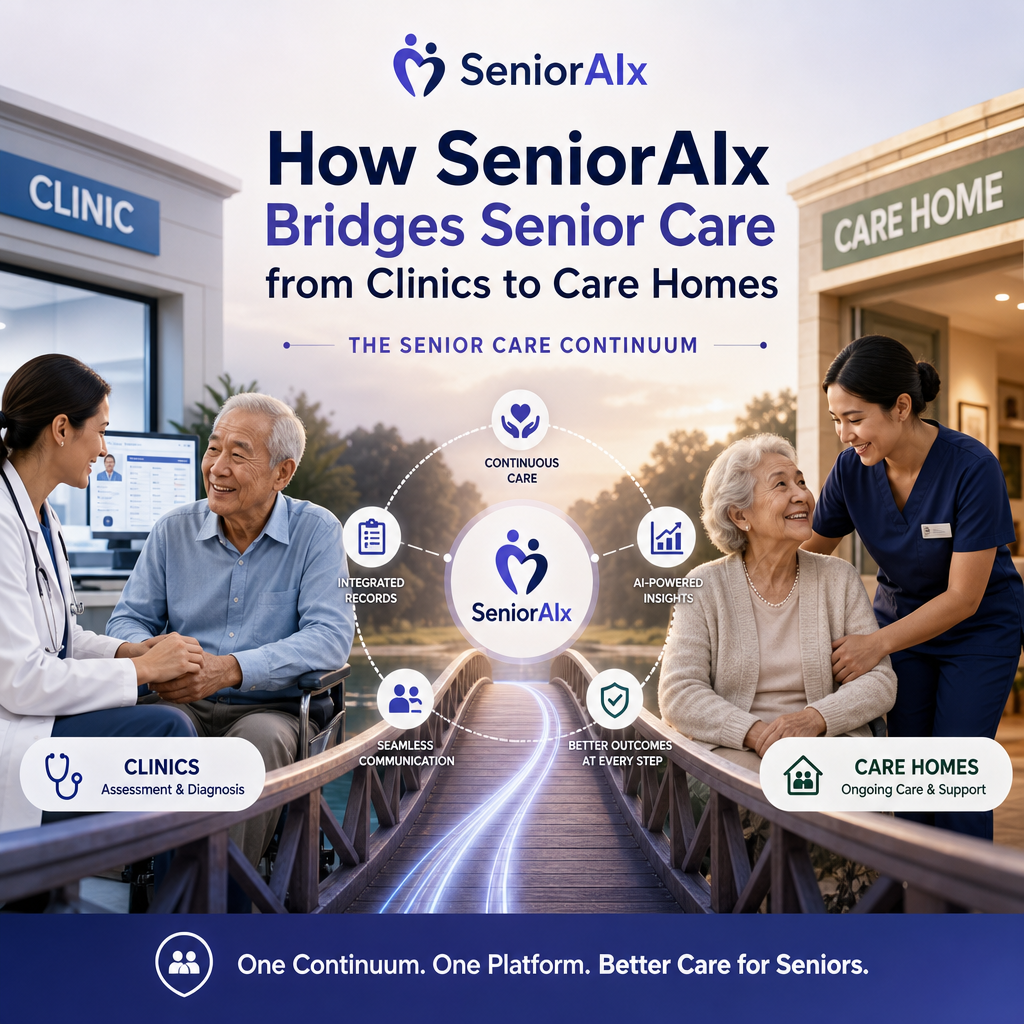
How SeniorAIx Bridges Senior Care from Clinics to Care Homes
From Clinics to Care Homes: How SeniorAIx Bridges the Senior Care Continuum
As older adults move through different stages of care, their needs often become more complex. A single person may visit a primary care clinic, transition to rehabilitation, receive support from home care providers, and later move into assisted living or a care home. At every step, information can be lost, routines can change, and communication gaps can affect outcomes.
This is where SeniorAIx brings real value. By connecting data, workflows, and decision-making across settings, it helps providers support seniors more consistently. In a world where fragmented care is still common, SeniorAIx is designed to strengthen the senior care continuum.

Why the Senior Care Continuum Needs Better Coordination
Senior care rarely happens in one place. It stretches across:

- Hospitals and specialist clinics
- Primary care practices
- Rehabilitation centers
- Home care services
- Assisted living communities
- Long-term care and nursing homes
Each setting may use different systems, documentation standards, and communication processes. That can lead to duplicate assessments, delayed interventions, medication errors, or missed warning signs.

For seniors and their families, this often feels stressful and confusing. They may have to repeat the same information many times, track multiple appointments, and manage transitions with limited support.
A connected approach can reduce these burdens. The goal is not only to improve efficiency, but also to make care safer, more personal, and more proactive.

How SeniorAIx Connects the Journey
SeniorAIx acts as a bridge between clinical care and everyday support. Rather than treating each care setting as a separate environment, it helps create a more unified view of the individual.

1. Shared Visibility Across Care Settings
One of the biggest challenges in senior care is incomplete information. A clinician may not know how a patient is coping at home. A care home team may not have immediate access to recent clinical updates. Family caregivers may be unaware of subtle changes until they become serious.
SeniorAIx helps bring these pieces together. With better visibility into health history, risk factors, care plans, and behavioral changes, providers can make more informed decisions.
This is especially important during transitions, such as:
- Hospital discharge to home care
- Clinic follow-up after rehabilitation
- Move-in to assisted living or long-term care
- Escalation from independent support to higher-level care
2. Earlier Detection of Risk
Small changes often come before major health events. A senior may begin walking less, eating poorly, sleeping differently, or showing signs of confusion. In many cases, these signals are easy to miss when care is spread across multiple providers.
SeniorAIx can help surface patterns earlier, giving teams the opportunity to act before a crisis develops. That may include:
- Identifying fall risk
- Flagging changes in mobility
- Monitoring medication-related concerns
- Detecting cognitive or behavioral shifts
- Highlighting social isolation or reduced engagement
Earlier detection supports better prevention, fewer avoidable hospital visits, and more timely care planning.
Supporting Both Clinical Teams and Care Home Staff
Technology in senior care must work for different kinds of users. Clinicians need reliable insights for diagnosis and treatment. Care home staff need practical tools that fit daily routines. Family members need clearer communication and confidence in what is happening.
SeniorAIx supports all three.
Clinical Benefits
For healthcare providers, SeniorAIx can improve continuity by offering more complete context around the patient’s condition, daily functioning, and response to care. This leads to smarter follow-up, better coordination, and more personalized interventions.
Operational Benefits in Care Homes
For care homes, staffing pressures are a constant reality. Teams need systems that help them prioritize attention, document changes efficiently, and spot issues early without adding unnecessary complexity.
SeniorAIx can support operations by helping staff:
- Track resident well-being more consistently
- Prioritize high-risk residents
- Improve handoffs between shifts
- Reduce reactive care
- Strengthen communication with external providers
Family Confidence
Families want reassurance that their loved ones are seen as individuals, not just records or room numbers. When communication improves and changes are identified early, trust grows. SeniorAIx helps make care more transparent and responsive, which is especially valuable during periods of transition.
Making Senior Care More Proactive
Too often, senior care becomes reactive. A fall happens. A medication issue escalates. Confusion worsens before anyone intervenes. By then, the response is more difficult, more expensive, and more distressing for everyone involved.
A stronger senior care continuum depends on a shift toward prevention and foresight. SeniorAIx supports that shift by helping providers move from isolated episodes of care to ongoing, connected support.
This proactive model can lead to:
- Better health outcomes
- Fewer emergency events
- Smoother care transitions
- More efficient staffing decisions
- A better experience for seniors and families
The Future of Connected Senior Care
As populations age, the need for coordinated senior care will only grow. Clinics, home care agencies, and care homes cannot afford to operate in silos. Seniors deserve continuity, dignity, and support that adapts as their needs change.
SeniorAIx represents a practical step in that direction. By linking insight with action across the full care journey, it helps bridge the gap between medical treatment and daily living support.
From clinics to care homes, the future of senior care is not just about more services. It is about better connection. And that is exactly where SeniorAIx can make a lasting difference.