

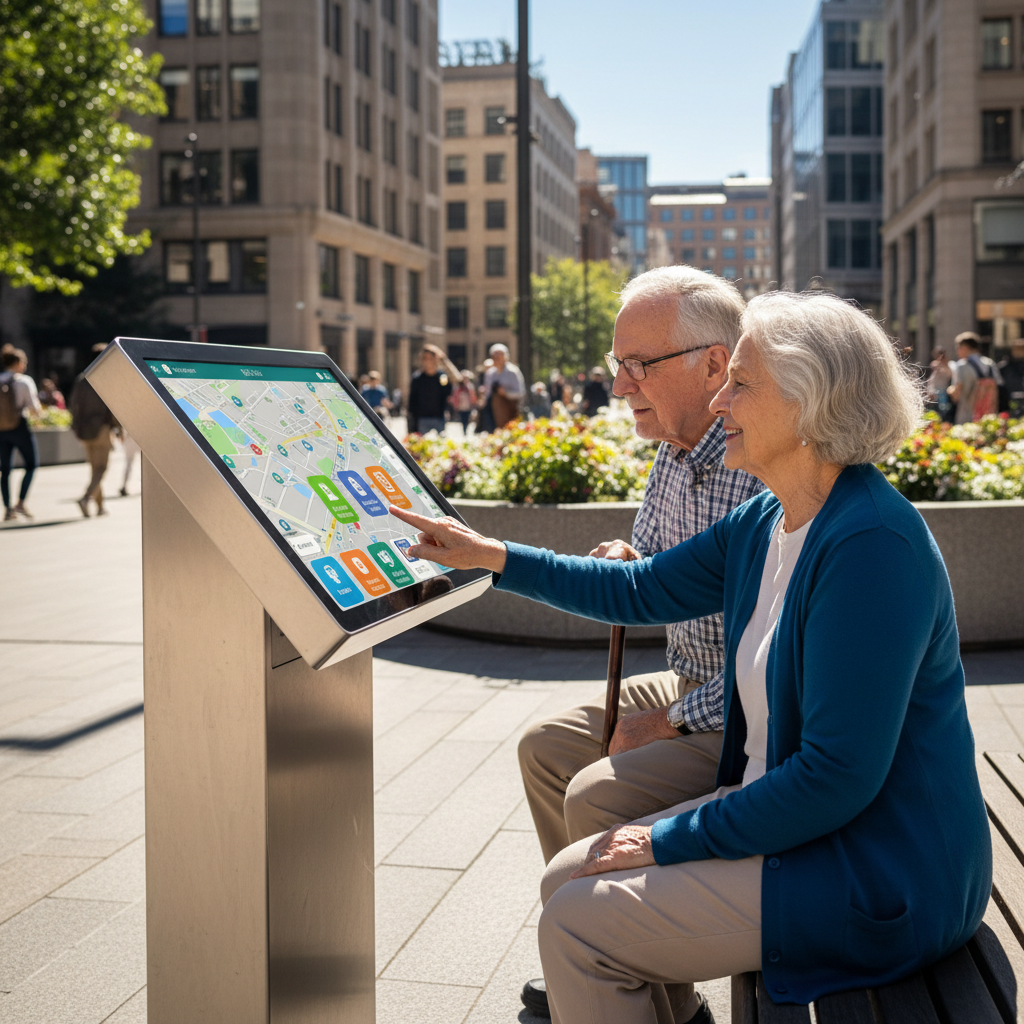
How AI Builds Age-Friendly Cities for Seniors
How AI Builds More Age-Friendly Cities for Seniors
As populations age, cities and communities must adapt so older adults can move, participate, and thrive. Artificial intelligence (AI) is a practical tool that helps planners, transit agencies, and neighborhood groups create environments that are safer, more accessible, and more responsive to seniors’ needs. This article explains how AI supports accessibility, transportation, public services, community engagement, digital inclusion, and smarter local planning — and how seniors can actively shape the outcomes.

Accessibility: Designing the physical city with data
AI helps cities analyze where barriers exist and prioritize fixes. Computer vision applied to street-level photos can detect missing curb ramps, uneven sidewalks, and poor signage faster than manual surveys. Machine learning models can rank repairs by impact so limited budgets go where they help the most.

Practical examples
- Automated sidewalk-condition mapping flags high-priority blocks for maintenance.
- Smart crosswalk systems adapt signal timing based on pedestrian pace data from anonymized sensors, giving older adults more crossing time.
- Image analysis helps identify locations where tactile paving or larger font signs are needed.
Transportation: Safer, more reliable mobility
Transport is often the key to independence. AI improves scheduling, reduces wait times, and helps tailor services for seniors. For example, predictive models can forecast demand on specific routes and adjust frequency or vehicle size. Community shuttle services and paratransit can be optimized so riders experience fewer delays.

City planners can use real-world examples — such as prioritizing improvements on bus lines 287, 364, 462, 463, 458 — to demonstrate how AI-driven changes reduce crowding, improve on-time performance, and create more comfortable transfers for older passengers.

What this looks like on the ground
- Dynamic routing for neighborhood shuttles to pick up riders with mobility needs without long detours.
- Real-time arrival displays and voice announcements tailored to simpler language and clearer timing.
- AI-assisted accessibility audits for transit stops — identifying where benches, shelters, or ramps are missing.

Public services: Faster, clearer, and more inclusive
AI can streamline how seniors interact with municipal services. Chatbots and voice assistants, trained on local service information, help older residents find answers without navigating complex websites. Natural language processing simplifies forms and translates materials into multiple languages, while routing algorithms speed up service calls for bulkier requests like permit processing or curbside assistance.
Examples of improved services
- Simple voice-driven portals for reporting broken benches, graffiti, or unsafe lighting.
- AI-driven scheduling that shortens wait time for permit inspections and neighborhood improvements.
- Personalized notifications about local events, accessible routes, or service interruptions.
Community engagement: Seniors shaping the AI agenda
For AI to serve older adults well, seniors must participate in setting priorities. Cities can run co-design sessions, citizen science projects, and participatory budgeting that use AI tools to summarize input and highlight common issues.

Ways seniors can take part
- Joining neighborhood mapping workshops to mark accessibility barriers and desired improvements.
- Participating in local data-review panels that help validate AI findings and correct biases.
- Helping design simple public interfaces — large fonts, clear icons, and voice options — then testing prototypes in real settings.
Digital inclusion: Skills, tools, and confidence
Digital inclusion is central to benefiting from AI-driven services. Communities can combine AI with human-centered training to bring seniors online and comfortable with new tools. Low-barrier devices, voice-first interfaces, and community tech hubs reduce friction.

Practical digital inclusion steps
- Local libraries and senior centers offering hands-on workshops for navigation apps and voice assistants.
- Device-lending programs that let seniors try tablets or smartphones before committing.
- Designing apps that default to simplified modes with larger touch targets and clear language.
Smarter local planning: Evidence-driven, responsive, and equitable
Planners can combine AI with community-sourced data to make better long-term decisions. Predictive analytics help forecast demographic shifts so neighborhoods can add benches, improve lighting, or expand transit before problems become acute. Importantly, AI outputs should be paired with public review and community oversight so priorities reflect local voices.
Conclusion: Practical, participatory, and positive
AI offers practical levers to make cities more age-friendly — from accessible streets to better transit, clearer public services, and inclusive digital tools. The most successful efforts are collaborative: seniors provide the lived experience, technologists provide tools, and municipalities coordinate action. When older adults are active partners — attending workshops, testing prototypes, and helping interpret data — AI becomes a tool that amplifies community priorities and builds cities that truly work for everyone.